


The Library
1995-2025

When AUI welcomed its first cohort in 1995, the campus was already equipped with its three-story library. Developments at the library reflect the technological and pedagogical changes that have shaped the university in its first thirty years.
This exhibit shows some of those changes, following the library as it moved from paper-based organization through increasingly complex data management. The exhibit also shows how the library has been working to collect items of enduring historical value to the university, the city of Ifrane, and the Middle Atlas through its Archives & Special Collections.


The Al-Quds Committee & AUI Inauguration
January 1995

Following a meeting of the Organization of Islamic Cooperation (OIC) in Casablanca in December 1994, King Hassan II of Morocco (r.1961-1999) invited the members to reconvene at the start of the year in the university on the campus of the newly finished Al Akhawayn University in Ifrane. This would mark the 15th gathering the OIC’s “al-Quds Committee”, founded in 1975 as a group of representatives from different countries whose attention has focused on the city of Jerusalem (ar. al-Quds).
The Al-Quds Committee met on 16-17 January 1995, during the same week that marked the inauguration of AUI. The group met in the main reading room of the university’s library. The meeting was opened with introductory remarks by His Majesty King Hassan II (d.1999), who chaired the committee, and Yasser Arafat (d.2004), leader of the Palestinian Liberation Organization (PLO) and President of the newly-created Palestinian Authority.

Selection of Images from the Al-Quds Committee & AUI inauguration (January 1995)
This selection of photos was acquired by the Mohammed VI Library in 2024 from Studio Zouitni in Rabat. The photographs were taken by André Zouitni (d.2024), who accompanied King Hassan II on royal visits to AUI and other locations in Morocco.


Royal Visit & Naming Ceremony of the Mohammed VI Library
30 August 2004

Following a visit to AUI in 2004 by His Majesty King Mohammed VI, the AUI Library unveiled its new name as the “Mohammed VI Library”. The photo above is from the naming ceremony, in which the king appears alongside then-AUI President Rachid Benmokhtar.
The library continues to enjoy the honor of being the only named building on campus and it is a testament to its leadership among academic libraries in Morocco that His Majesty gave his name to it. The library is today well-known throughout Morocco through its formal Arabic title, “Khizānat Muhammad al-Sādis”.


The naming of the library was followed by the adoption of a new logo (below) in 2012, which would remain in use by the library on and off until 2021. The same logo remains above the exterior of the library’s front door.

The Card Catalog
How did we used to find books?

The AUI Library organizes its collections using what is called the “Library of Congress” classification system, in which call numbers represent different disciplines or subject areas. Books and ebooks can be searched quickly and easily through an online system. But it wasn’t always that way.
In the 1990s, like many other libraries in the world it had a physical “card catalog” system (pictured above). Every item in the collection was connected to one or more physical cards, containing the essential metadata (title, author, date of publication, subject, and call number) that would allow someone to search for relevant volumes and find them in the stacks.

Cards were classified alphabetically by author, title, or subject. So, someone looking for a book about the Maghrib edited by Michel Le Gall could either search under “Le Gall” in the author card catalog, “Morocco” in the subject catalog, or The Maghrib in Question in the title catalog.
The card catalog enabled users to be autonomous in their research. Unlike most libraries in Morocco, the AUI Library was from the outset an “open stacks”, meaning that once users knew where a book was, they could walk to the shelves and retrieve it themselves, without the need for a formal request or assistance from a librarian.


M6L Website
2004-2025
The Mohammed VI Library, like many university libraries world-wide, recognized early on the potential the internet carried for sharing information about its collections and services. The images here show the evolution of its website overtime, beginning with the launch of its first website in 2005.


M6L Archives & Special Collections
Remembering AUI & Ifrane


In 2021, the Mohammed VI Library launched a project to establish the M6L Archives and Special Collections. This new part of the M6L collects books, documents, photographs, ephemera, and other objects of enduring historical value to Al Akhawayn University, the city of Ifrane, and the Middle Atlas region.


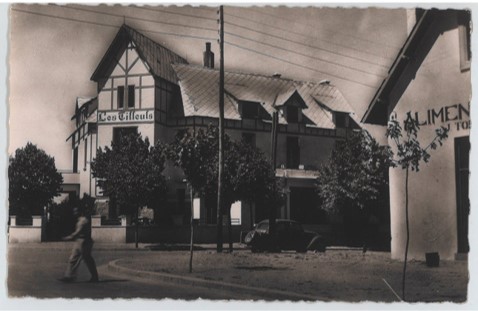
The collections have quickly grown to include thousands of audio-visual materials, documents, and artifacts from AUI’s early history. In addition, the “Ifrane and Middle Atlas” collections have expanded to hundreds of historic photographs, postcards, paper ephemera and artifacts relating to the history of Ifrane.

Beginning in 2025, the AUI community will have access to many of the digital items from the Archives & Special Collections through ADRAR (Al Akhawayn Digital Repository & Archives). The repository takes its name from the Tamazight word for mountain. ADRAR aims to become the AUI online institutional repository for digital-born and digitized documents, photos, and audio-visual materials of enduring historical value to the university and Ifrane.
Selection of Photos from the M6L Archives & Special Collections “Ifrane & Middle Atlas Collections”
These photos & postcards are from a collection related to the history of Ifrane and the Middle Atlas region. The collections follow development of the city of Ifrane from its foundations in 1928, with most materials relating to the colonial period through independence in 1956.
Ifrane & Middle Atlas Postcards


Ifrane & Middle Atlas Photographs


Digitizing AUI’s History on VHS Cassettes (1995-c.2008)
The Mohammed VI Library houses a collection of nearly 600 VHS cassette tapes, which record the early history of events and activities on the university campus from 1995 until the late 2000s. The team has been digitizing these collections over the past year and the selection here shows some of the highlights of AUI’s early history.